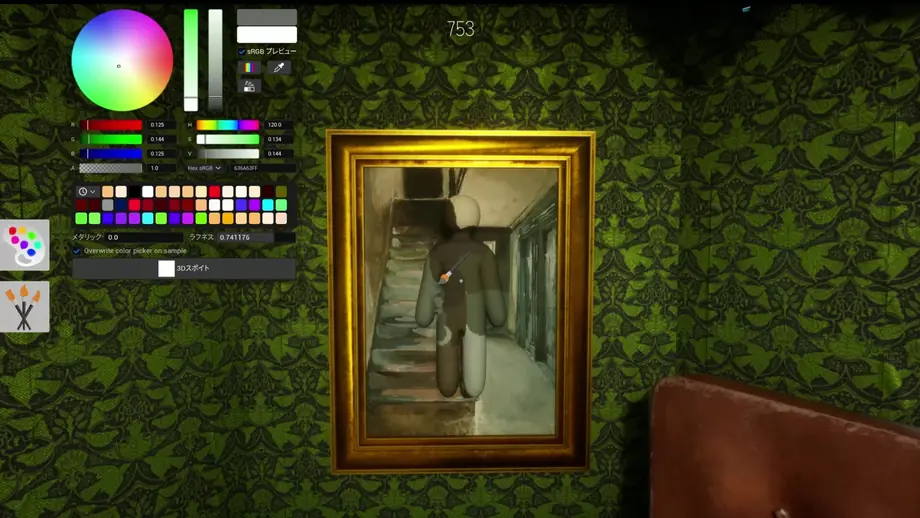
Quick answer: the best hiding combines color, shape, and timing
The most reliable way to hide in MECCHA CHAMELEON is to choose the hiding spot before you paint. Many new players paint the whole body first, then look around for a background that seems close enough. That order is backwards. In a real round, the stage should tell you which colors to use: wall tone, floor tone, shadow tone, trim lines, box edges, and small repeated patterns. When the body is painted from the local scene instead of from memory, it stops looking like a character that has been colored in and starts looking like part of the stage.
Seekers do not detect players only by exact color. They notice round outlines, shadows that do not match the wall, a shape floating in the middle of open space, a pattern that suddenly breaks, or a hider who panics and moves. That is why a strong MECCHA CHAMELEON hiding guide has to cover more than color picking. You need to decide where your outline will be broken, which direction your pose should face, which part of the body should be darker, and when staying still is safer than running.
Think of the hider role as observation and camouflage, not drawing skill. You can be a weak artist and still become harder to find if you consistently follow three rules: split the body into two or three local color zones, place the outline against props, edges, or shadows, and move only when there is a reason. If you improve those habits, your hiding spots become readable to you and less readable to the seeker.
If you search for the strongest hiding spot in MECCHA CHAMELEON, do not expect one answer that works on every stage. Prioritize wall-floor seams, prop edges, textured surfaces, and places outside the seeker's first sightline, then check whether a nearby second background gives you a short escape option.
Paint by surface, not by one flat color
A useful disguise is rarely one clean paint bucket. The stage usually has separate planes: a wall, a floor, a shadow band, a prop edge, a rail, a box face, or a repeated texture. Split your character around those planes and keep the visible text or pattern work simple. The goal is not to create a beautiful costume; the goal is to remove the first thing the seeker would notice.
| Step | What to do | Common mistake |
|---|---|---|
| Divide the background | Read the hiding spot as two or three areas, then map those tones onto the body: upper wall, lower floor, and a shadow or trim line. | Painting the entire body one similar color, which leaves the character floating across a wall-floor boundary. |
| Match brightness first | Before chasing the exact hue, make sure the body is not much brighter or darker than the surroundings. | Choosing the right blue or green family but leaving it too bright, making the hider glow against the scene. |
| Darken the outer edge | A slightly darker outer zone helps the body sit against shadows, corners, and object edges. | Using one even tone from center to edge, which keeps the full silhouette visible. |
| Use small pattern cues | Add short lines or color blocks only where the background already has lines, trim, or clutter. | Drawing large decorative shapes that become a unique landmark for the seeker. |
Silhouette control can matter more than perfect color
From the seeker's view, a nearly correct color can still fail if the body outline is sitting in open space. A player hidden in the middle of a flat wall creates a readable shape, even if the paint is close. A player whose outline is split by a box, corner, shadow, rail, or textured background may survive with less accurate color because the eye has less complete shape information to process.
Look for places where the stage already has visual breaks: the line between wall and floor, the edge of a crate, the side of a column, darker shadow patches, cluttered textures, or areas near the screen edge. Corners are useful, but obvious corners are also checked early by experienced seekers. If you use a corner, do not simply sit in the deepest point. Slide slightly so the body line overlaps a background line rather than forming a new separate curve.
Pose discipline matters too. A wide pose creates extra outline and makes the body look intentional. A compact pose, turned in the same direction as nearby objects, gives the seeker fewer clues. Once the pose is set, resist micro-adjustments. Tiny movements can be more revealing than a slightly imperfect color, especially when the seeker is already scanning a suspicious area.

What makes a hiding spot strong
A hiding spot is not chosen by darkness or by one permanent strongest position. Read the seeker's opening sightline, the amount of visual information in the background, the edges that can break your outline, and the next surface you could reach.
Many edges
Wall-floor seams, prop edges, columns, and shadow borders give your outline something to merge with.
Missed by first scan
A spot that is not directly centered when the seeker enters often survives the most dangerous opening glance.
Visual clutter
Textures, props, and repeated patterns make small color errors less obvious than empty flat surfaces.
A backup route
A hiding spot with a nearby second background is safer than a perfect-looking dead end.
Work backward from why the seeker found you
The fastest way to improve is to separate the reason you were spotted. Once you understand what the seeker read, the next correction becomes obvious.
| Why you are spotted | Hider adjustment | Seeker read |
|---|---|---|
| The color is close but too bright | Match brightness before hue, and make outer edges slightly darker in shadow. | Bright outlines or glowing patches stand out even when the hue is close. |
| Your round silhouette remains visible | Break your outline against walls, boxes, pillars, or floor edges instead of stopping in an open flat area. | A strange curve or broken pattern becomes a candidate even with good paint. |
| You move because you feel unsafe | Move only when the seeker looks away, and choose the next hiding spot before moving. | Sudden motion and repeated escape directions are easy to track. |
| You rely on obvious corners | Offset from the exact corner so background lines overlap your body line. | Common corners, steps, and box backs belong in the first scan route. |
| You assume the obvious strongest spot is always safe | Offset from the familiar corner, overlap your outline with a background line, and check for a nearby second surface. | Common corners and box backs are easy to predict, so matching color alone may not protect you. |
Movement timing often decides the round
The most common hider mistake in MECCHA CHAMELEON is moving because of anxiety, not because the situation changed. If the seeker has not clearly seen you, stillness is often stronger than escape. Consider moving only when the seeker turns away, another object or player has their attention, the timer makes the current plan impossible, or your current spot is already being inspected closely enough that staying will fail.
When you do move, keep the path short. A long straight sprint across a bright floor creates the exact motion cue the seeker wants. Move from one busy or dark background to another, and stop before the seeker finishes their scan. It helps to choose your second spot while you choose your first one. That way you are not planning while already exposed.
Movement also has a social rhythm in friend lobbies and streamer sessions. If everyone is panicking and rotating constantly, seekers learn to track motion rather than evaluate camouflage. A calmer hider who moves once at the right time can survive longer than a hider who found the better first spot but kept adjusting.
Searchers often want one best hiding spot, but the same spot can succeed or fail depending on paint, posture, timing, and the seeker camera. After each loss, choose one cause: color, silhouette, movement, or location. Fixing one cause per round improves faster than changing everything at once.
If you are not being checked, stay still
The urge to adjust can reveal you. Let the seeker spend time elsewhere unless your position is truly compromised.
Pick the destination before moving
Running first and thinking later often ends with the hider stopping on a bright or empty surface.
Read the seeker's route
If the seeker scans left to right, moving briefly into the already-cleared side can be safer than crossing their next target area.
A beginner practice routine
You do not need to memorize every stage immediately. You will improve faster if each round tests one small hiding skill and one failure reason. Use this routine in solo practice, friend matches, or viewer-participation lobbies.
Limit yourself to three paint zones
Use one wall tone, one shadow or floor tone, and one edge detail. Too many colors slow your decision-making and often make the body noisier.
Name the reason you were found
After each failed hide, classify the cause: color, brightness, outline, movement, spot choice, or timing. Fix only one category next round.
Play a seeker round
Seeing the stage from the seeker's perspective teaches you which hiding habits are obvious. This is often faster than hiding ten more rounds without feedback.
Verify changing facts on Steam
Stage details, support notes, updates, and availability can change. Use the official Steam page for current game facts and this wiki for evergreen strategy habits.
FAQ